
Designing Documents for the Reader Who Can Say No
A method for multi-stakeholder strategic communication (and why your best documents keep getting stuck)

The strategic note had everything: evidence, logic, credible scenarios, and a clear ask. The team behind it had weeks of structured work invested. Senior leadership reviewed it internally and approved it.
Then it went out. And it stalled.
People asked for clarifications that the document already contained. Objections appeared that no one on the drafting team had anticipated. Weeks passed. The file stalled.
I have now seen this pattern for years across quantum, deep tech, and public-private strategy work. At IBM Quantum, at Cambridge Quantum, and at Creative Destruction Lab, the same issue kept surfacing. Teams believed the quality of the work would carry the decision. Often it did not.
The problem was not weak content. The problem was document design.
The gap after awareness
Awareness is improving. For many organizations, the next gap appears after awareness, when a high-stakes strategic note lands in front of a board member, a CFO, a policy director, or a budget authority who can say no.
At that point, a document optimized for the expert who wrote it often underperforms with the stakeholder who must approve it.
In deep tech, the files at risk are not only public funding notes. They are board pre-reads, strategic partnership memos, grant narratives, capital requests, and internal commercialization cases.
That is the gap this method addresses.
Cognitive asymmetry in plain language
In the white paper, I define cognitive asymmetry as the gap between how experts and decision-makers process the same situation.
Experts see models, assumptions, trajectories, and edge cases. Decision-makers see risk, trade-offs, constraints, timing, and political exposure.
Same document. Different reconstructed meaning.
This is not a moral failure and not a communication style issue. It is structural.
Behavioral and economic research has described related mechanisms for decades. Framing effects (Tversky and Kahneman) show that interpretation changes with presentation. Information asymmetry (Akerlof) shows how uneven knowledge distorts decisions.
In strategic drafting, these dynamics combine in very practical ways. A paragraph that reassures an expert can alarm a minister. A statement that satisfies one funder can feel vague or risky to heavy users.
When we do not design for that divergence, we create avoidable failure modes.
The method: panels, personas, and the Sections×Personas matrix
The method has three core components.
First, panels. We define four review panels that represent recurring decision lenses:
Policy and public legitimacy
Finance and ROI
Expert trajectory and technical defensibility
Heavy user continuity and fairness
Second, personas. Inside each panel, we define explicit personas with concrete criteria, constraints, and decision thresholds. These are not marketing personas. They are decision personas. How these personas are constructed and calibrated is the core of the practitioner work and depends heavily on the tacit context that only leadership can surface.
Third, matrix evaluation. We evaluate the draft with a Sections x Personas matrix.
Rows are document sections: context, strategic ask, value proposition, risk scenarios, commitments, and implementation.
Columns are personas.
Each cell gets a status: “OK”, “To strengthen” or “Missing or risky”.
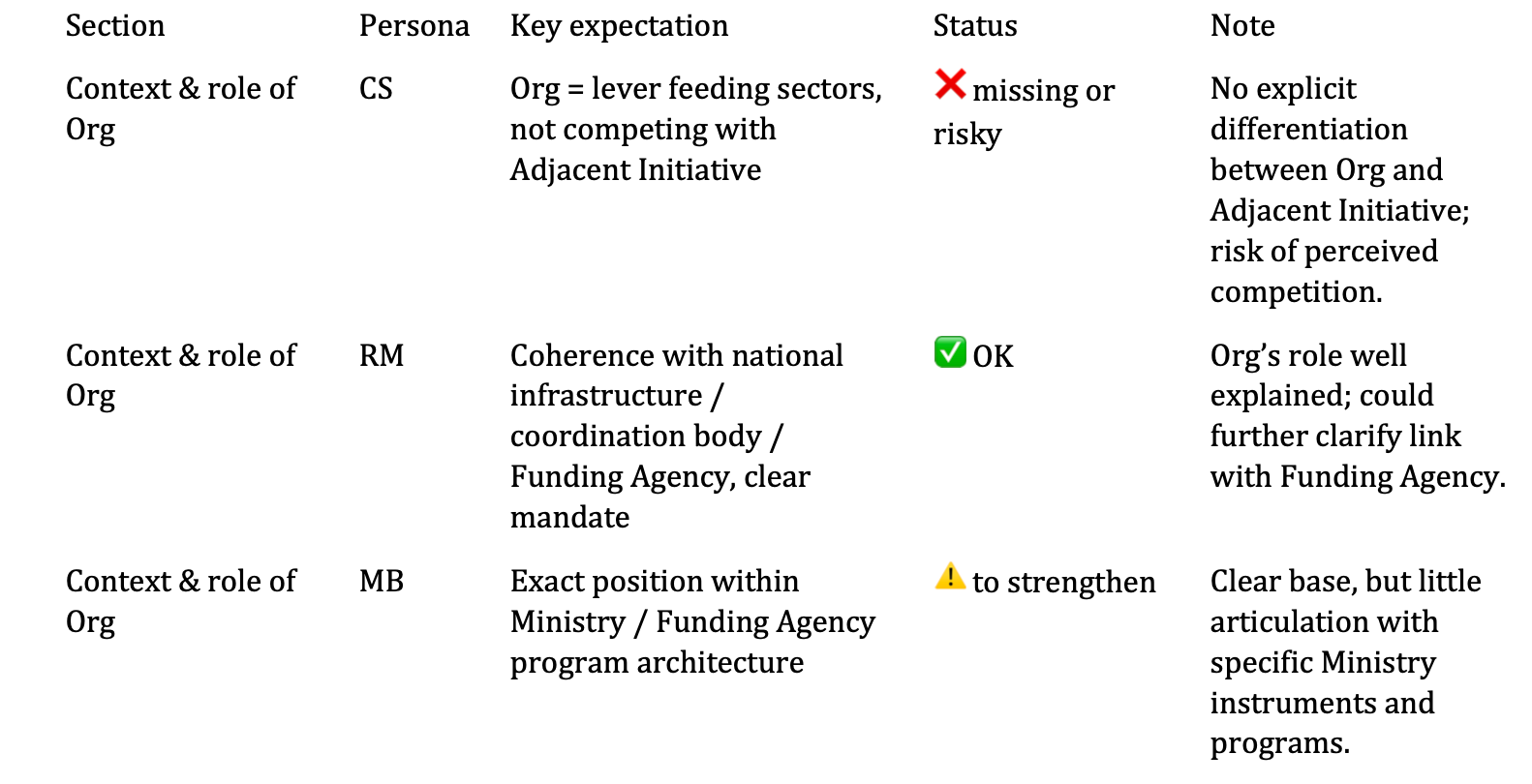
In the anonymized case documented in the white paper, status distribution across section-persona evaluations was:
31% OK
42% to strengthen
28% missing or risky
That distribution changed the conversation immediately. The team saw that the issue was not line editing quality. The issue was structural coverage across critical readers.
The matrix is the visible artefact. The real difficulty is choosing the right readers and the right thresholds.
Where AI helps, and where it does not
AI is useful in this process, but bounded.
It helps with simulation. We can ask the model to read as a specific persona and identify likely objections.
It helps with stress-testing. We can isolate phrases that trigger unintended interpretations for specific readers.
It helps with drafting. We can produce candidate text blocks that fill precise matrix gaps.
What AI does not do is replace judgment.
It does not know tacit political context unless humans surface it.
It does not own ethical choices.
It does not carry accountability for the decision.
Leadership keeps authorship and responsibility. AI is an accelerator inside a human-governed process.
What happened in the anonymized case
The engagement took about 2 working days of structured external involvement.
The client described it as compressing several weeks of internal back-and-forth into a few concentrated working sessions.
The resulting note entered an executive decision process.
The director also said they could never have written the executive summary that fast without this structure.
Beyond the final document, the work produced reusable assets: a persona library, a reusable matrix template, and draft blocks for recurring themes such as complementarity, user commitments, and financial framing.
The key client insight is one I agree with strongly:
The differentiator is not the AI model itself, and not the panel template by itself. The differentiator is knowing which questions to ask leadership so tacit context becomes explicit.
No model can extract that context from documents alone.
Who this is for
This approach is useful when three conditions are present:
Multiple decision layers read the same file through different lenses.
Stakes are high enough that one misreading can delay or derail the outcome.
Intensive users depend on the trajectory and will scrutinize operational implications.
Under those conditions, treating reader divergence as a design constraint is not optional. It is a risk control practice.
Typical engagement formats:
Targeted service on one strategic file.
Local capability implementation inside your team.
Hybrid model combining both.
If this sounds familiar, the issue is probably not that your team is weak at writing. The issue is that your document is being evaluated by readers it was never explicitly designed for.
That is fixable.
Full white paper PDF:

If you have a file this quarter that must survive more than one decision lens, send me a note at mehdi@qap-partners.com with 'asymmetry' in the subject line. In a 60-90 minute conversation, I can usually tell whether reader-frame divergence is a real risk and where the pressure points sit.